
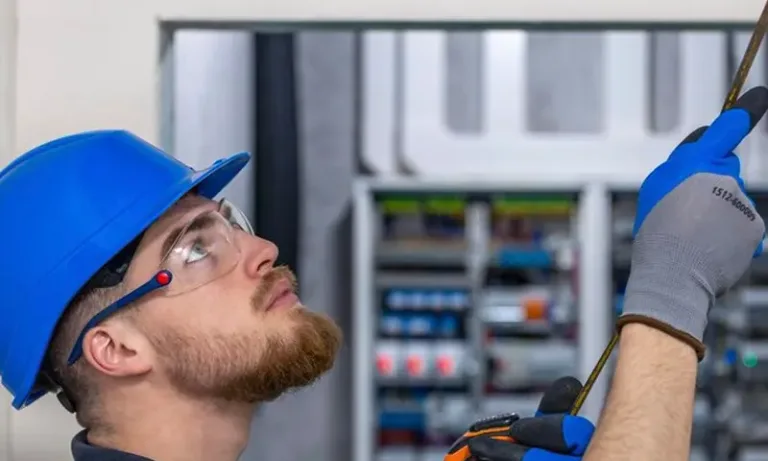
Electrician Near Me in Jersey
Most people search for an electrician when something has already gone wrong. Here is what actually matters when you pick one, and what a competent electrician should be doing for your property before there is a problem.
What “electrician near me” really means on a nine-by-five island
Jersey is nine miles by five. On an island that size, distance is rarely the deciding factor — every address is a short drive from every other. So when you search for an electrician near me in Jersey, proximity is not the useful filter. Qualification is.
The questions worth asking are simpler: is the contractor NICEIC approved, do they know the island’s building stock, and can they get to you quickly when something fails. Trust A Trader has been trading in Jersey since 1969 — over 55 years of working on the same properties, the same wiring vintages and the same recurring faults.
That accumulated familiarity is worth more than a postcode match. An electrician who has seen how Jersey granite properties were rewired in the 1970s knows where to look first.
What NICEIC approval actually means
NICEIC approved contractor status is not a logo you buy. It is an assessment regime.
An approved contractor is inspected regularly by an independent assessor, who reviews completed work, tests equipment, checks calibration records and confirms that installations meet the current wiring regulations. If the standard slips, approval is withdrawn.
In practice, three things follow from that.
First, the work is designed to meet a published standard rather than the electrician’s personal habits. Second, test instruments are calibrated, so the readings on your certificate mean something. Third, there is a route to escalate if a job goes wrong — an accountable body outside the contractor.
Electrical work is one of the few trades where a bad job is invisible until it is dangerous. A poor paint finish announces itself. A poorly terminated connection sits quietly behind a faceplate for years, warming up, until it does not. Third-party assessment is the only practical way for a customer to verify quality they cannot see.
EICRs: what they cover and when you need one
An Electrical Installation Condition Report is a structured inspection and test of a fixed electrical installation. It is not a visual glance around the property.
The inspection covers the consumer unit, the condition of cabling and accessories, earthing and bonding arrangements, the presence and function of RCD protection, and evidence of overloading, deterioration or damage. Circuits are tested for insulation resistance, earth continuity and fault loop impedance.
Findings are coded. C1 means danger present and requires immediate action. C2 means potentially dangerous and requires remedial work. C3 is an improvement recommendation, not a failure. An installation with any C1 or C2 is reported as unsatisfactory.
You typically want an EICR in four situations.
Buying a property. A survey will not test the electrics. An EICR tells you whether you are inheriting a rewire.
Selling. A satisfactory report removes an obvious negotiating lever from the buyer.
Letting. If you rent a property out, you need to be able to show the installation is safe for your tenants, and a periodic report is the usual way to evidence it. Check the current requirements that apply to rented dwellings in Jersey, as they differ from the UK’s.
Periodically, as an owner-occupier. If you cannot remember your last inspection, or the property has changed hands or been altered since, it is overdue.
Why older properties accumulate problems
Jersey has a lot of older housing stock, and older housing stock accumulates layers.
A property built before domestic electrics were common gets a first installation. Then a kitchen is refitted and circuits are extended. Then an extension is added by a different contractor. Then a garden office, an outside socket, a shower, a loft conversion. Each stage may have been acceptable at the time.
The problem is cumulative. Nobody stands back and looks at the whole installation. Circuits get extended beyond what the original cable was sized for. Junction boxes end up buried under floors where they cannot be inspected. Old rubber or fabric-insulated cable survives in a wall behind newer work and slowly goes brittle. Earthing arrangements from three different eras coexist.
An EICR is the only reliable way to see the installation as a single system rather than a stack of individual jobs.
Warning signs you should not ignore
Some symptoms mean call an electrician this week. Others mean stop using the circuit now.
Act immediately if you notice a burning or fishy smell near sockets or the consumer unit, scorch marks or discolouration around a faceplate, a socket or switch that is warm to the touch, a buzzing or crackling sound from an accessory, or any tingle when touching an appliance or tap.
Book an inspection promptly if breakers trip repeatedly, lights dim when appliances start, sockets are loose in the wall, you still have an old fuse-wire board rather than a modern consumer unit, or you have no RCD protection at all.
RCD protection matters more than most homeowners realise. A circuit breaker protects the cable from overload. An RCD protects the person — it detects current leaking to earth and disconnects in milliseconds. An installation without it relies entirely on you never making contact with a fault.
Do not attempt electrical work yourself. Testing requires calibrated instruments and a defined procedure, and the failure mode is not a botched job — it is a fire or a fatality.
What to do in an electrical emergency
If it is safe to do so, switch off the affected circuit at the consumer unit, or the main switch if you cannot identify the circuit. Unplug what you can reach safely.
Do not touch anyone who may be in contact with a live conductor. Isolate the supply first. Do not throw water at an electrical fire. Do not reset a breaker repeatedly to see whether it holds — it is tripping because something is wrong, and forcing it closed removes your protection.
If there is smoke, fire or anyone injured, call the emergency services first. Then call an electrician.
Trust A Trader provides emergency electrical services across Jersey with fast response on emergency electrical repairs and minimal disruption to your property. Alongside emergency call-outs, the company handles EICRs, full electrical installations, electrical repairs and appliance repair.
Conclusion
An electrician near me in Jersey is not really a question of distance — on an island this size, it is a question of who is qualified, accountable and available when it matters. NICEIC approval gives you an independently assessed standard. An EICR gives you an honest picture of what is actually in your walls. Together they turn electrical safety from guesswork into something you can evidence.
Jersey’s No.1 Electrician Since 1969.
Speak to a Jersey Electrician
Call us on